


When a duplex filter cloth underperforms, the alloy is usually blamed first. In practice the weave is just as often the culprit — and it is the variable most enquiries leave out.
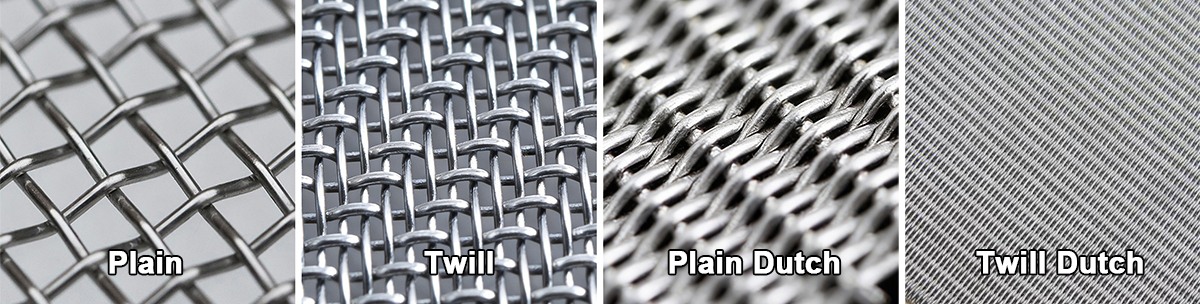
There are two separate decisions inside every wire mesh specification, and they are frequently collapsed into one. The material grade determines how long the cloth survives the chemistry it is exposed to. The weave type determines what the cloth can actually separate, how much differential pressure it takes before it deforms, and how it behaves under vibration or backwash.
Get the grade right and the weave wrong, and you have a corrosion-resistant screen with the wrong filtration rating. Get the weave right and the grade wrong, and you have a precisely rated screen that perforates in six months. This article is about the second decision.
Plain weave — the default, and usually the right starting point
In plain weave, each warp wire passes over one weft wire and under the next, in both directions. Every intersection alternates, producing a square, uniform opening.
Its advantages are structural simplicity and cost. Openings are predictable, the cloth lies flat, aperture can be calculated directly from mesh count and wire diameter, and it is the most economical construction to produce. For screening, machine guarding, sieving, insect and debris screens, and general-purpose filtration up to roughly 200 mesh, plain weave should be your first question rather than your last resort.
The limitation is mechanical. At coarse mesh counts paired with fine wire, plain weave offers only moderate resistance to abrasion and impact, and the cloth can flex enough at the intersections to work-harden over time. Where a screen carries real load or sits in a vibrating assembly, plain weave is often the wrong answer even when the mesh count looks correct on paper.
Aperture, in one line: opening (mm) = 25.4 ÷ mesh count − wire diameter (mm). It is a fixed relationship — which is why “100 mesh” alone is not a specification until the wire diameter is stated with it.
Twill weave — for load, vibration and heavier wire
Twill weave changes the pattern: each wire passes over two or more wires and under two or more, producing the characteristic diagonal line across the cloth.
That single change buys three things. The cloth becomes denser and more flexible. It can carry a heavier wire at a given opening, which raises strength and wear resistance without sacrificing the aperture you need. Or, at the same mesh count, it can run a finer wire than plain weave would tolerate — useful when open area and flow rate matter more than raw strength.
Twill is the construction to ask for where the screen carries mechanical load, sits in a vibrating or pulsing assembly, needs to flex during forming, or where the duty cycle includes repeated backwash. It is also the common choice at the finer end of the square-weave range, where plain weave becomes fragile.
Dutch weave — where the filtration rating is the actual requirement
Dutch weave is a different idea altogether. Instead of a balanced grid, it uses two different wire diameters: a heavier warp wire, with fine weft wires driven tightly together until the cloth is dense.
The openings are not square and there is no straight-through path. Flow follows a tortuous route through the cloth, which is precisely what allows very fine particle retention while keeping usable flow rates. This is why Dutch weave, not plain weave, is the standard construction for precision filtration.
It is also why Dutch weave is specified differently. Rather than a single mesh count, it is commonly rated by absolute filter rating — the largest hard spherical particle that will pass through the cloth under defined test conditions, typically established by a bubble point test. Two cloths both called “Dutch weave” can have entirely different retention if only the mesh count is quoted.
Variants worth knowing: plain Dutch is the standard form; twilled Dutch combines the two-diameter structure with the twill pattern for an even tighter weave and finer filtration; reverse Dutch inverts the warp and weft roles to produce the smallest openings and the highest filtration rating, typically used at 200–500 mesh for fine particulate in aggressive liquids.
Comparison at a glance
| Weave | Structure | Opening shape | Typical range | Choose it when |
|---|---|---|---|---|
| Plain | One wire over, one under, both directions | Square, uniform | Up to ~200 mesh | Screening, guarding, general filtration, cost-sensitive duties |
| Twill | Each wire passes over two or more | Square, denser | 20–300 mesh | Mechanical load, vibration, heavier wire at a given opening |
| Plain Dutch | Heavy warp, fine weft driven tight | Wedge-shaped, tortuous path | 100–400 mesh | Precision filtration specified by absolute rating |
| Reverse Dutch | Warp and weft roles inverted | Smallest openings | 200–500 mesh | Fine particulate in aggressive liquids under pressure |
Why the two decisions have to be made together
A Dutch weave in 316L will filter just as finely as the same weave in super duplex 2507. It simply will not last in seawater — the chloride content pits and perforates it long before the filtration rating becomes the limiting factor. Conversely, specifying super duplex for a plain-weave screen is wasted money if the duty actually needs 300-mesh retention that only a Dutch construction can deliver.
This is why a good enquiry carries both halves. “2507, 200 mesh” is incomplete. “2507, reverse Dutch, 200 mesh, 0.05 mm wire, in seawater at 40 °C, 5 bar differential, EN 10204 3.1 certificate required” is a specification anyone can quote against — and one that will not come back to you as a failure report.
What duplex changes about the weave
Duplex grades bring one practical advantage and one practical constraint to the loom.
The advantage is strength. With a yield strength roughly double that of 316L, duplex wire lets you run a finer wire at a given duty than an austenitic grade would require — which raises open area and flow, or lets the cloth survive higher differential pressure without deforming.
The constraint is that high-strength wire has more springback than austenitic wire, so fine-count duplex cloth is more demanding to weave consistently. Mesh count, aperture and weave uniformity need tighter in-process control, and not every supplier holds those tolerances at the fine end. If your specification is above roughly 200 mesh, ask what the supplier actually weaves in-house rather than assuming the full published range is stocked.
One further point that belongs to the grade, not the weave, but is worth repeating because it is missed so often: duplex grades are used within roughly −50 °C to +300 °C. Prolonged exposure above about 300 °C promotes sigma-phase precipitation, which reduces both toughness and corrosion resistance. And because the microstructure contains a ferritic phase, duplex cloth is weakly magnetic — disqualifying where non-magnetic material is specified.
The four things to include in your enquiry
- Grade — by UNS number: S32205 / S31803 (2205) or S32750 (2507)
- Weave — plain, twill, plain Dutch, twilled Dutch or reverse Dutch
- Geometry — mesh count and wire diameter, plus width, length or part drawing
- Duty — medium, chloride level, temperature, differential pressure, and the documents you need
Full specifications, including a plain-weave table from 3 to 200 mesh with aperture, open area and weight, are on our duplex stainless steel wire mesh page. If you would rather not translate your process conditions into a weave specification yourself, send us the medium, temperature, required particle retention and available pressure drop, and we will propose one.
Post time: Sep-29-2026