

✔ Send Your Mesh Specification Now
✔ Get Free Sample Consultation
✔ Customized production available

Duplex Stainless Steel Wire Cloth | 2205 & 2507 Specification | DXR
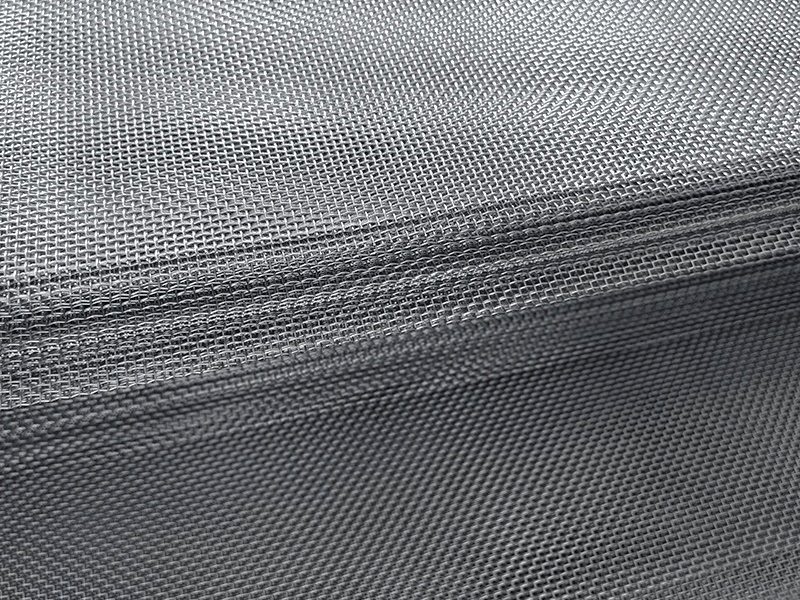
What Duplex Stainless Steel Wire Mesh Is?
Duplex stainless steel is defined by its microstructure: ferrite and austenite coexist in roughly equal proportion, rather than one phase as in conventional austenitic 304/316L. That two-phase structure is the reason the material behaves differently on a wire cloth line and in service.
The ferritic phase raises strength — yield strength is close to double that of 316L — while the austenitic phase keeps toughness and ductility workable. High chromium, molybdenum and nitrogen contents move the pitting resistance equivalent number (PREN) well above 316L, so the mesh resists chloride pitting, crevice corrosion and chloride stress corrosion cracking in environments that perforate standard austenitic mesh.
In practice duplex mesh is specified when a filter or screen has to survive seawater, brine, sour gas, acidic process streams or aggressive cleaning cycles without being replaced every season — and when the buyer wants that performance without paying for a nickel-base alloy.
2205 vs 2507 vs 316L — Which Grade Do You Need?
| Property | Duplex 2205 (UNS S32205) | Super Duplex 2507 (UNS S32750) | 316L (for reference) |
| PREN (typical) | 33 – 38 | 40 – 43 | ≈ 26 |
| Yield strength, min. | 450 MPa | 550 MPa | 170 – 300 MPa |
| Tensile strength, min. | 620 – 655 MPa | 795 MPa | 485 MPa |
| Chloride / seawater resistance | Excellent | Superior | Moderate |
| Relative material cost | Moderate | Higher | Lowest |
| Best fit | Brackish water, general chemical process, most industrial filtration | Continuous seawater immersion, hot concentrated chlorides, sour (H₂S) service | Mild process water, non-chloride duties |
Grade Designations and Equivalents
| Common name | UNS | EN / Werkstoff | GB / China | Typical use |
| Duplex 2205 | S32205 / S31803 | 1.4462 | 022Cr22Ni5Mo3N | General duplex duties, best cost-to-performance balance |
| Super duplex 2507 | S32750 | 1.441 | 022Cr25Ni7Mo4N | Seawater, desalination, high-chloride and sour service |
| Lean duplex 2304 | S32304 | 1.4362 | 022Cr23Ni4MoCuN | Cost-saving alternative where extreme chlorides are not present |
Chemical Composition (wt %, typical specification limits)
| Grade | C ≤ | Si ≤ | Mn ≤ | P ≤ | S ≤ | Cr | Ni | Mo | N |
| 2205 (S31803) | 0.03 | 1 | 2 | 0.03 | 0.02 | 21.0–23.0 | 4.5–6.5 | 2.5–3.5 | 0.08–0.20 |
| 2205 (S32205) | 0.03 | 1 | 2 | 0.03 | 0.02 | 22.0–23.0 | 4.5–6.5 | 3.0–3.5 | 0.14–0.20 |
| 2507 (S32750) | 0.03 | 0.8 | 1.2 | 0.035 | 0.02 | 24.0–26.0 | 6.0–8.0 | 3.0–5.0 | 0.24–0.32 |
Common Plain-Weave Specifications
| Mesh / inch | Aperture (mm) | Wire dia. (mm) | Open area (%) | Weight (kg/m²) |
| 3 | 6.27 | 2.2 | 62 | 7 |
| 4 | 5.45 | 0.914 | 76 | 2.1 |
| 5 | 4.36 | 0.711 | 76 | 1.3 |
| 6 | 3.04 | 1.22 | 50 | 4.3 |
| 8 | 2.5 | 0.559 | 67 | 1.5 |
| 10 | 2.08 | 0.46 | 67 | 1.1 |
| 12 | 1.74 | 0.457 | 68 | 1.4 |
| 14 | 1.36 | 0.46 | 57 | 1.4 |
| 16 | 1.21 | 0.376 | 55 | 1.2 |
| 20 | 0.95 | 0.315 | 58 | 0.95 |
| 24 | 0.78 | 0.274 | 55 | 0.85 |
| 30 | 0.61 | 0.234 | 48 | 0.8 |
| 40 | 0.44 | 0.193 | 50 | 0.8 |
| 50 | 0.36 | 0.152 | 46 | 0.58 |
| 60 | 0.3 | 0.122 | 50 | 0.45 |
| 80 | 0.198 | 0.12 | 44 | 0.58 |
| 100 | 0.154 | 0.1 | 37 | 0.5 |
| 120 | 0.13 | 0.081 | 40 | 0.39 |
| 150 | 0.115 | 0.055 | 48 | 0.21 |
| 180 | 0.09 | 0.051 | 41 | 0.24 |
| 200 | 0.086 | 0.041 | 46 | 0.17 |
Extract from our standard plain-weave range; figures are nominal and vary with wire tolerance. Dutch, twill Dutch and reverse Dutch specifications are quoted per drawing.
Weave Types and Where Each One Works
Plain weave
One wire over, one wire under. Square, uniform openings and the most economical option — the default choice for screening, guarding, sieving and general-purpose filtration up to about 200 mesh.
Twill weave
Each wire passes over two or more wires. Produces a denser, more flexible cloth that handles heavier loads and vibration while allowing a finer wire at the same mesh count.
Plain Dutch weave
Heavier warp wires with tightly packed weft wires. Fine, wedge-shaped openings with high flow and good dirt-holding capacity — the standard construction for precision filtration in the 100–400 mesh band.
Reverse Dutch weave
The warp and weft roles are inverted, giving the smallest openings and the highest filtration rating, typically 200–500 mesh, for fine particulate in aggressive liquids.
Applications
Oil & gas
Seawater intake screens, sand-control and shale-shaker screens, sour-gas (H₂S) filtration, wellhead and pipeline strainer elements.
Desalination & marine
RO pre-filtration, intake trash screens, brine strainer baskets, shipboard and offshore platform filtration, coastal infrastructure.
Chemical & petrochemical
Acid and alkali filtration, reactor and catalyst support screens, heat-exchanger and column internals, chemical tanker cargo-tank protection.
Power & environmental
Flue-gas scrubber and FGD screens, cooling-water filtration, wastewater and saline effluent treatment.
Pulp & paper, mining
Corrosive liquor screening, classifier and dewatering screens where chloride-laden process water destroys standard mesh.
Food & pharmaceutical
Hygienic filter elements for CIP and SIP cycles, where aggressive cleaning chemicals are the main corrosion driver.
Fabrication and Custom Supply
√ Slit to any width, cut to length, cut discs, rings, gaskets and shaped blanks
√ Cylindrical, conical and pleated filter elements; spot-welded, seam-welded or argon-arc welded seams
√ Baskets, trays, frames and test sieves built to drawing
√ Multi-layer laminated and sintered filter packs for higher differential pressure
√ Edge treatments: raw/selvedge, welded edge, looped edge, bound with metal strip
√ Sample swatches of the actual weave sent before you commit to a production order
Quality Control and Documentation
√ Raw wire checked against the mill certificate; grade verified before it reaches the loom
√ In-process control of mesh count, wire diameter, aperture and weave uniformity
√ Final inspection of width, length, surface condition and packing
√ Mill test certificate to EN 10204 3.1 supplied with each shipment, traceable to the heat number
√ Packing: inner kraft or plastic film, outer woven cloth or carton, then wooden case or pallet for export
Frequently Asked Questions
2205 (UNS S32205) is the economical standard duplex grade with a PREN of roughly 33–38. 2507 (UNS S32750) is a super duplex grade with higher chromium, molybdenum and nitrogen, giving a PREN of about 40–43 and higher yield strength. Choose 2205 for brackish water, general chemical service and most filtration duties; specify 2507 for continuous seawater immersion, hot concentrated chlorides or sour (H₂S) service.
Yes, partially. The ferritic phase in the duplex microstructure makes the mesh weakly magnetic, unlike fully austenitic 304 or 316L mesh. If your application requires non-magnetic material, tell us at the enquiry stage so we can propose an alternative grade.
Standard production runs from 2 mesh to 500 mesh with wire diameters from 0.025 mm to 2.5 mm in plain, twill, Dutch and reverse Dutch weave. Finer counts and non-standard wire diameters are quoted on request.
Yes. We supply rolls, cut sheets, discs, rings, baskets, cylinders, cone and tube filter elements, edge-welded and spot-welded assemblies, and multi-layer laminated or sintered filter packs built to your drawing.
Each shipment can be supplied with a mill test certificate to EN 10204 3.1 covering chemical composition and mechanical properties, plus a packing list, certificate of origin and inspection report where required. State your document requirements when requesting a quote.
Give us the UNS grade, weave type, mesh count, wire diameter, roll width and length (or the part drawing), the operating medium and temperature, the quantity and the documents you need. With those seven items we can quote the same day.
Write your message here and send it to us